· Marisol Vance
Why Your Ukulele Tips Forward on the Strap
The strap is on, both ends are seated, and the ukulele still will not stay where you put it. You let go, the headstock swings toward the floor, and the fretting hand goes back up to catch it — which is the exact job you fitted a strap to remove. Players call it neck dive, and a ukulele finds it more easily than any larger instrument in the case rack.
It is quick to correct once you know what you are correcting, and that is where most attempts go astray: three different faults produce the same sensation, and the fix for one of them makes another worse. Fitting the strap in the first place is covered step by step in how to put a strap on a ukulele; this guide begins with it already on.
Three faults, one sensation: your ukulele tips forward on the strap
Everything below starts with the same observation. Stand up, let go with both hands, and watch what moves.
| What you see | What is happening | Where the correction lives |
|---|---|---|
| The headstock drops, the body stays where it is | Neck dive — the instrument is rotating about its anchors | The top anchor, then the height |
| The whole ukulele arrives lower, at the same angle | The band is travelling on your shoulder | The band and where it crosses you |
| It was right an hour ago and is long now | The slider has crept | The hardware |
They feel identical from behind the instrument, because all three end with the fretboard further from your fretting shoulder than it was. They are not the same problem. Shortening the strap on a band that is sliding pulls the ukulele into your collarbone and leaves the sliding untouched; chasing sliders on a genuine dive changes nothing at all.
Why a ukulele leans more readily than a bigger instrument
A ukulele is an unusually lopsided object. The body is a small, thin, nylon-strung soundbox with very little material in it. The headstock, at the other end, carries the hardware for four tuners on a short piece of wood, and it is the densest part of the whole instrument. Geared tuners hold more metal than friction pegs, so two otherwise identical ukuleles can behave quite differently the moment they are hung from a strap.
What follows is a short lever with the mass bunched at one end. On a bigger fretted instrument a large body counterweights the headstock; on a ukulele there is far less body to do that work, so the point the instrument actually wants to hang from sits further toward the neck than anyone guesses by looking at it.
Size follows the same logic. A soprano feels it most, because it puts the least body against the same tuner hardware; a baritone starts behaving like a small guitar. It is simply the shape of the thing, and it is why the anchor points matter as much as they do.
The anchor line decides the resting angle
A strapped instrument settles until its heaviest part hangs as low as it is allowed to. Your two anchor points define a line, and the ukulele rotates about that line until it stops.
On a ukulele the top anchor is usually a loop behind the nut, so the line runs almost the full length of the instrument and the headstock is held inside it. That geometry is what prevents the dive before it starts.
Let that top anchor travel down toward the body and the line gets shorter. The headstock is left outside it, gains back the leverage the loop was taking away, and the neck goes down. So when the neck drops, look at the top anchor before you touch a slider. Three things to check with your eyes:
A loop that has crept in front of the nut. It should sit behind the nut, between the nut and the tuners. Forward of it, the loop is both fouling the strings and shortening your anchor line.
A lace that has loosened. Knots creep with movement. A tie that has opened by a finger's width has moved your top anchor down the neck.
A soundhole hook seated on the neck side of the rim. It belongs on the part of the rim closest to the tail; on the neck side it pulls the wrong way. The no-drill guide covers what each anchor rests against.
The bottom anchor has its own say in the resting angle, and where a tail button belongs on the wood is a separate question — that one is answered in the strap button guide.
Sitting hides it, standing shows it, turning proves it
Run the same hands-off test three times, in this order, and the answer usually falls out of it.
Seated. Your thigh and the inside of your strumming forearm carry part of the instrument whether you intend them to or not. A setting that is going to dive still behaves here, which is why a fault that shows up seated is a real one — the anchor has moved, and length alone rarely does that.
Standing. Both helpers vanish and the strap works alone. A dive that appears only on your feet points at length: the body hangs low, the headstock gets a long lever, and the neck follows it down. Where to set that length is in how to use a ukulele strap.
Turning. Take a step and turn your shoulders. Anything loose declares itself on the turn rather than standing still, because the instrument swings out and has to settle again. An unsnugged loop and a crept slider both show here first.
What your own frame changes about it
Half of this problem happens on the instrument. The other half happens on you, and almost nothing written about neck dive says so.
The strap's job ends at your shoulder; what the band does after that depends on the shoulder it lands on. A more sloped shoulder gives a band less of a shelf to sit on, so it drifts forward toward the collarbone over a song or two. As the band moves forward, your top anchor effectively comes down — and the neck comes down with it. The instrument never changed. Your shoulder did.
Chest depth works from the other direction. A deeper chest holds the back of the ukulele out from you, which lifts the neck on its own. A flatter one lets the instrument lie close, so more of the angle is decided by the strap and less by the contact. The same length reads differently on two players.
What you are wearing joins in. A woven band grips a knitted sleeve and stays exactly where it is put. A slick shell, or a bare shoulder in summer, gives any band less to hold on to — so if the dive only turns up in warm weather, look at where the band has arrived before you touch anything on the instrument.
What the band itself does about it
Two properties of the strap decide whether your top anchor stays where you set it.
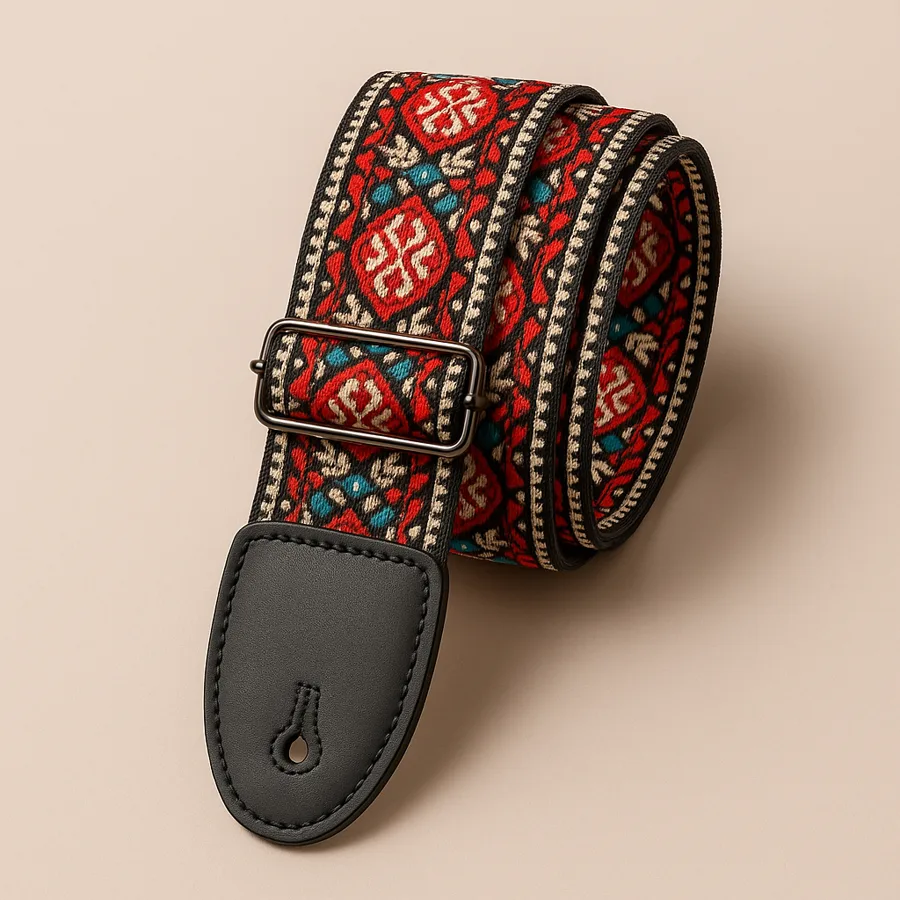
Width. A wide band lies across more of the shoulder, so there is more of it in contact and much less tendency to roll up into a cord and travel. Ours is a full 5 cm, which is also what keeps the instrument's weight spread instead of concentrated in a line.
Surface. A woven jacquard band has real texture in it — raised thread, a pattern you can feel with a thumb — and that texture is what holds it against a shoulder or a sleeve. Flat webbing has a smooth face and slides on both.
The ends do the same job at the other anchor: PU (faux) leather keyhole ends seat on a strap button and stay seated, so the bottom of your anchor line stops being a variable. And at 82 to 137 cm there is enough band left over to reach behind the nut on a soprano rather than settle for an anchor halfway down the neck.
Band width, which is what keeps the strap lying flat on the shoulder instead of rolling forward
— Fretweave product specification, 2026
Adjustable range, enough band to reach a headstock loop on a soprano and still set the length short
— Fretweave product specification, 2026
Money-back window, long enough to set the length and live with it across a few sessions
— Fretweave refund policy, 2026
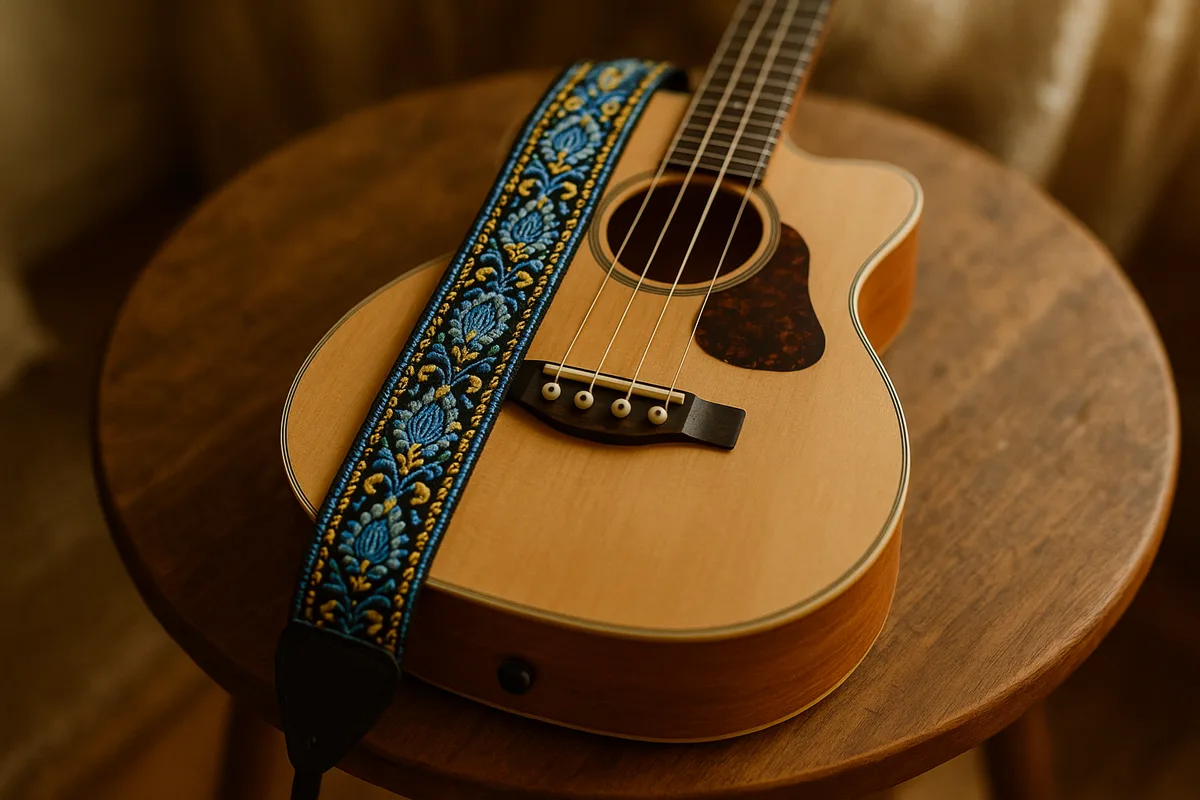
Ukulele tipping forward on the strap: the order to correct it in
Change one thing, then repeat the hands-off test. Three changes at once tell you the dive stopped without telling you which one stopped it.
1. Seat both ends. Push the keyhole fully over the button head so the narrow part of the slot takes it, and pull a lace or loop snug behind the nut. The commonest dive I am shown at the end of a lesson is an end that was never fully on.
2. Put the top anchor back where it belongs. Behind the nut, on the tail side of a soundhole rim, tight enough that it cannot ride up over the tuners. This is the single change that moves the resting angle most.
3. Push the sliders back and reset the length. Woven bands creep, so seat the slider firmly rather than assuming it held, then set the length standing.
4. Bring the body up. Higher on the chest shortens the lever the headstock is working with and brings the fretboard closer to your fretting shoulder at the same time.
5. Then look at the anchor positions themselves. One tail button and a headstock loop hang at a different angle from two buttons, and that comparison belongs in the button guide before anything gets drilled.
One thing not to correct with: your body. Hitching the shoulder, tilting backward, or holding the neck up with the fretting hand all hide the dive while leaving it in place — and the fretting hand goes straight back to gripping, which is the thing you were solving. The reference point for a correct hold is in how to hold a ukulele.
Frequently asked questions
Why does my ukulele neck dive when the strap is on?
Because the headstock is the densest part of a light instrument, and it rotates the ukulele about the line between your two anchor points until it hangs as low as that line allows. The usual cause is a top anchor that has travelled down the neck, which shortens the line and hands the headstock its leverage back. Reseat the loop behind the nut first, then bring the body higher on your chest.
Does a wider strap stop a ukulele tipping forward?
A wide band changes the half of the problem that happens on your shoulder. Lying across more of the shoulder, it stays where you put it instead of rolling forward toward the collarbone, and a top anchor that stays put is a neck that stays up. Our band is a full 5 cm of woven jacquard for that reason, and it stays lying flat across a session, so the top anchor you set is the one still holding the neck up an hour later.
My ukulele only tips forward when I stand up — what does that mean?
Seated, your thigh and your strumming forearm quietly carry part of the instrument, so a setting that will dive still behaves in a chair. Standing removes both helpers and the strap has to do all of it alone. A fault that appears only on your feet is nearly always length: the ukulele is hanging low enough for the headstock to get a long lever. Set the length standing and it disappears.
A neck that stays up is a band that stays where you set it. Our embroidered ukulele strap is 5 cm of woven jacquard on two sliders with PU (faux) leather keyhole ends, so the anchor line you build holds through a session — and the same band moves onto a guitar or a bass when you pick one of those up.

Marisol Vance · Ukulele teacher and strap collector, 9 yrs
Marisol has taught ukulele for nine years and re-strapped more than 200 instruments, and the neck that will not stay up is the question she is asked most often at the end of a first strap lesson.